Explore the building blocks of matter — from counting atoms to predicting their behavior across the periodic table.
Exam Weight: 7–9% | Topics 1.1–1.8
Chemistry deals with incredibly large numbers of atoms and molecules. A single drop of water contains roughly 1021 molecules. To make these numbers manageable, chemists use the mole (abbreviated mol), one of the seven SI base units. The mole bridges the gap between the atomic world (individual atoms and molecules) and the macroscopic world (grams, liters) that we can measure in the lab.
The molar mass of an element is the mass of one mole of that element, expressed in grams per mole (g/mol). It is numerically equal to the element’s average atomic mass found on the periodic table (in amu). For compounds, the molar mass is the sum of the molar masses of all atoms in the chemical formula.
Dimensional analysis (factor-label method) is the core problem-solving strategy for mole conversions. Always start with what you know, then multiply by conversion factors until you reach the desired unit. Units must cancel properly.
| Conversion | Formula | Units |
|---|---|---|
| Mass → Moles | n = mass ÷ molar mass | g ÷ (g/mol) = mol |
| Moles → Particles | Particles = n × 6.022 × 10²³ | mol × (particles/mol) |
| Moles → Mass | mass = n × molar mass | mol × (g/mol) = g |
| Particles → Moles | n = particles ÷ 6.022 × 10²³ | particles ÷ (particles/mol) = mol |
A mass spectrometer is an instrument that separates atoms or molecules based on their mass-to-charge ratio (m/z). In AP Chemistry, you will encounter mass spectra of elements to determine isotopic composition and calculate average atomic mass. Understanding mass spectrometry is essential because it provides direct experimental evidence for the existence of isotopes.
Block diagram of a mass spectrometer — sample is ionized, accelerated, deflected by a magnetic field, and detected. (Wikimedia Commons)
The x-axis shows m/z (mass-to-charge ratio, which for singly-charged ions equals the mass number). The y-axis shows relative abundance (%). Each peak represents a different isotope of the element.
Every pure substance has a fixed, definite composition by mass. This is described by the Law of Definite Proportions (also known as the Law of Constant Composition): a given compound always contains the same elements in the same proportions by mass, regardless of the sample size or source.
Percent composition tells you the percentage of the total mass contributed by each element in a compound. This is useful for identifying unknown compounds and verifying purity.
Combustion analysis is used to determine the empirical formula of organic compounds (containing C, H, and sometimes O). The compound is burned in excess O₂, and the masses of CO₂ and H₂O produced are measured.
Unlike pure substances, mixtures can vary in composition. They are classified as either homogeneous (uniform throughout, e.g., saltwater, air, brass) or heterogeneous (non-uniform, e.g., sand and water, granite). The key distinction from pure substances is that mixtures do not have a fixed composition.
When a mixture contains substances with known formulas, you can use elemental analysis, mass data, or reaction data to determine the amount of each component present. These are often algebraic problems.
Mixtures can be separated based on differences in physical properties:
| Technique | Separates Based On | Example Use |
|---|---|---|
| Filtration | Particle size (solid from liquid) | Sand from saltwater |
| Distillation | Boiling point differences | Separating ethanol from water |
| Chromatography | Differential affinity for stationary vs. mobile phase | Separating pigments in ink |
| Evaporation | Volatility (remove solvent) | Recovering NaCl from saltwater |
| Centrifugation | Density differences | Separating blood components |
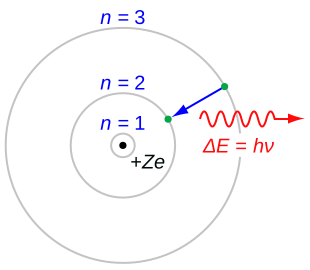
Atoms consist of a dense, positively charged nucleus (containing protons and neutrons) surrounded by electrons occupying energy levels (shells) and subshells. Understanding electron configurations is foundational — it explains periodic trends, bonding, and reactivity.
Bohr model of the atom showing discrete energy levels (shells). (Wikimedia Commons)
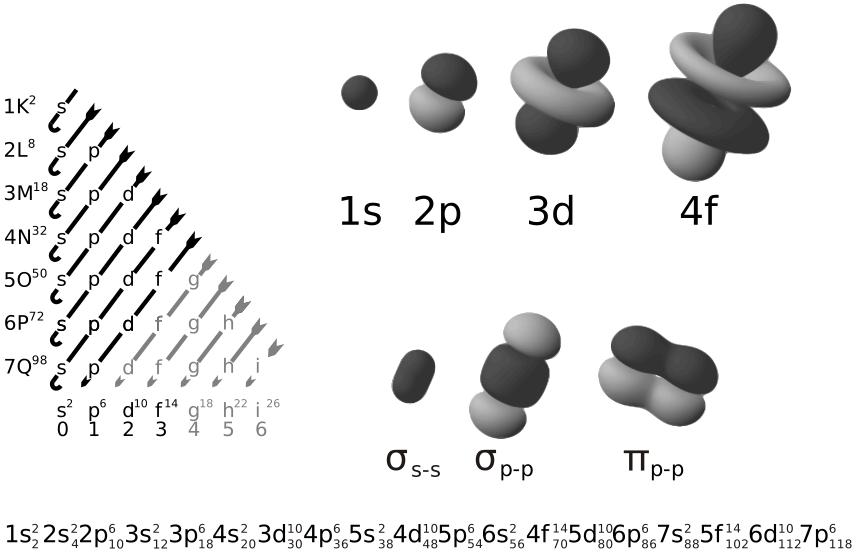
Shapes of s, p, d, and f orbitals. Each orbital holds a maximum of 2 electrons. (Wikimedia Commons)
| Particle | Symbol | Charge | Mass (amu) | Location |
|---|---|---|---|---|
| Proton | p⁺ | +1 | 1.007 | Nucleus |
| Neutron | n⁰ | 0 | 1.009 | Nucleus |
| Electron | e⁻ | −1 | ~0 (5.49 × 10⁻⁴) | Electron cloud |
Atomic number (Z) = number of protons = defines the element. Mass number (A) = protons + neutrons. Isotopes have the same Z but different A (different numbers of neutrons).
| Subshell | # of Orbitals | Max Electrons | Shape |
|---|---|---|---|
| s | 1 | 2 | Spherical |
| p | 3 | 6 | Dumbbell (along x, y, z axes) |
| d | 5 | 10 | Cloverleaf (various orientations) |
| f | 7 | 14 | Complex multilobed |
List each occupied subshell with a superscript for the number of electrons. Noble-gas shorthand uses brackets around the previous noble gas core.
This is a critical concept that appears frequently on the AP exam:
Each electron is described by four quantum numbers:
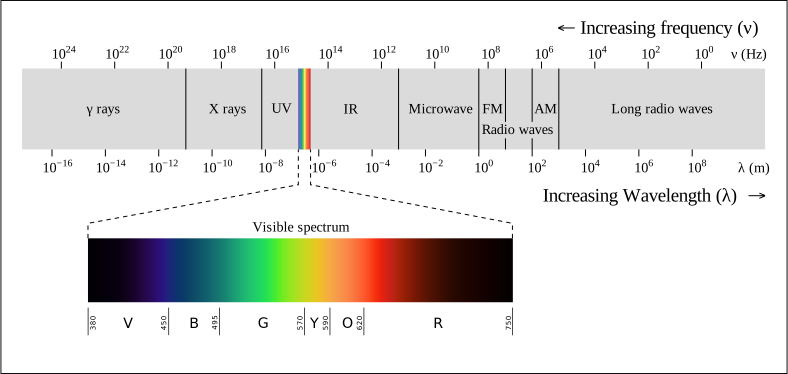
Photoelectron spectroscopy provides direct experimental evidence for the shell structure of atoms and validates electron configurations. It works by hitting atoms with high-energy photons (usually X-rays or UV light) and measuring the kinetic energy of the ejected electrons. The difference between the photon energy and the kinetic energy gives the binding energy of each electron.
The electromagnetic spectrum — PES uses high-energy UV or X-ray photons to eject core and valence electrons. (Wikimedia Commons)
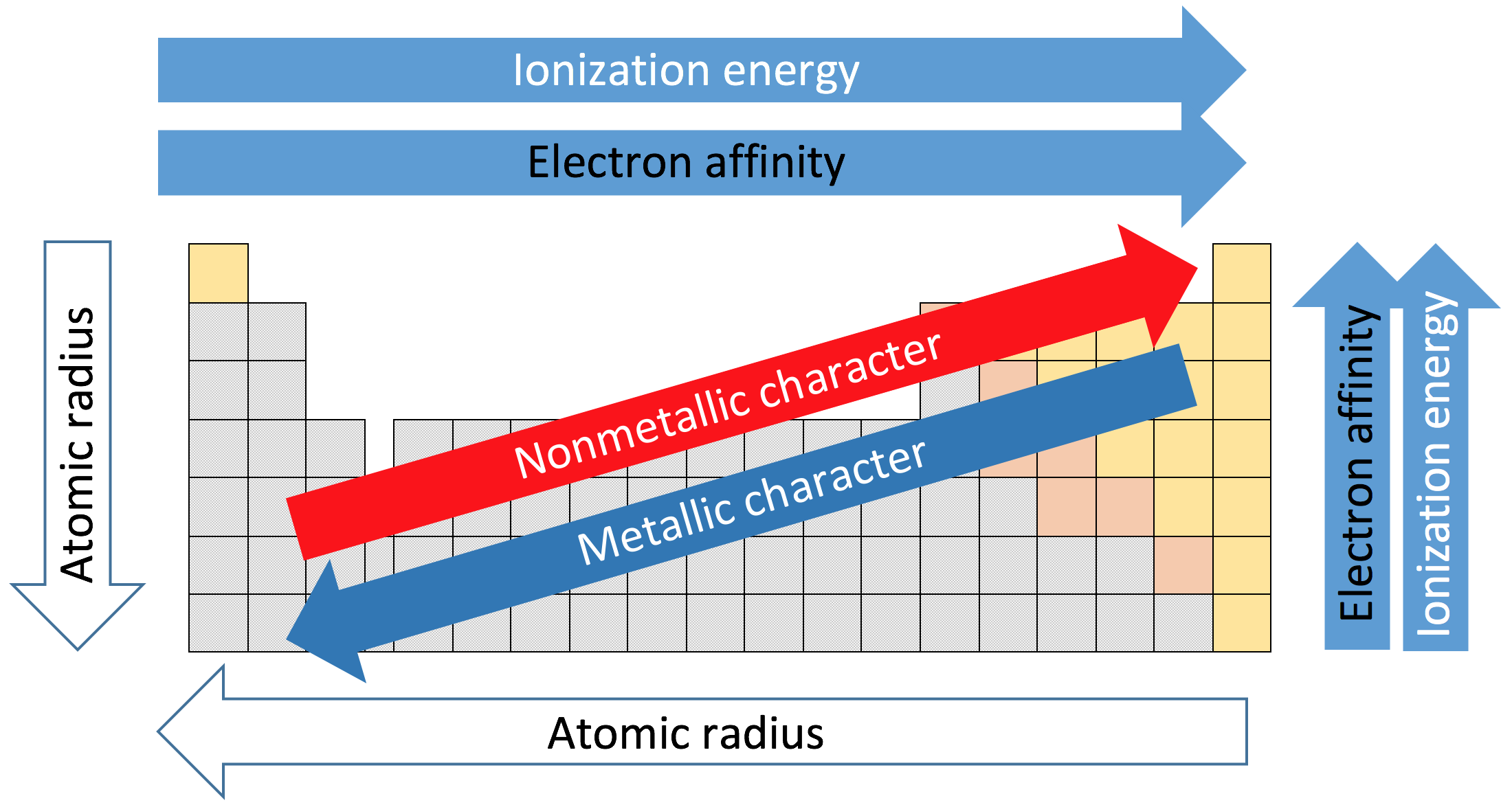
The periodic table organizes elements so that properties change predictably. Understanding these trends is fundamental to predicting chemical behavior. The underlying explanation for all periodic trends is effective nuclear charge (Zeff) and electron shielding.
Major periodic trends: atomic radius, ionization energy, electron affinity, and electronegativity. (Wikimedia Commons)
First ionization energies of elements, showing the periodic pattern and notable exceptions. (Wikimedia Commons)
Each successive ionization energy is larger than the previous one (removing an electron from a more positive ion is harder). A large jump in successive IEs indicates that a core electron is being removed (breaking into the next shell).
Valence electrons are the electrons in an atom’s outermost energy level (highest principal quantum number). They determine an element’s chemical properties, bonding behavior, and reactivity. Elements in the same group have the same number of valence electrons, which is why they exhibit similar chemistry.
| Group (1–18 numbering) | Valence Electrons | Examples |
|---|---|---|
| Group 1 (Alkali metals) | 1 | Na [Ne] 3s¹ |
| Group 2 (Alkaline earth) | 2 | Mg [Ne] 3s² |
| Groups 13–18 | Group # − 10 | C (Group 14) = 4 VE |
| Transition metals (Groups 3–12) | Varies; includes s + d electrons | Fe: 2 (4s²) shown commonly |
Ionic compounds form when metals transfer electrons to nonmetals. The result is oppositely charged ions held together by electrostatic attraction (the ionic bond). Both ions typically achieve a noble-gas electron configuration.
Lattice energy is the energy released when gaseous ions come together to form a solid ionic compound (or equivalently, the energy required to completely separate an ionic solid into gaseous ions). It directly correlates with the strength of ionic bonds in the crystal:
Test your knowledge of Unit 1. Click "Show Answer" to reveal the correct choice and explanation.
1. A sample of an element contains two isotopes: isotope A has a mass of 10.01 amu and a relative abundance of 19.9%, and isotope B has a mass of 11.01 amu and a relative abundance of 80.1%. What is the average atomic mass of the element?
2. How many moles of oxygen atoms are present in 0.50 mol of Ca(NO₃)₂?
3. A compound has the empirical formula CH₂O and a molar mass of approximately 180 g/mol. What is its molecular formula?
4. Which of the following represents the correct ground-state electron configuration for chromium (Cr, Z = 24)?
5. A PES spectrum for an element shows three peaks. The peak with the highest binding energy has a relative height of 2, the middle peak has a relative height of 2, and the peak with the lowest binding energy has a relative height of 3. Which element is this most likely?
6. Which of the following correctly ranks the atoms in order of increasing atomic radius?
7. The first ionization energy of oxygen is lower than that of nitrogen. Which of the following best explains this observation?
8. Which of the following ionic compounds would be expected to have the highest lattice energy?
9. The successive ionization energies (in kJ/mol) of an unknown element X are: 578, 1817, 2745, 11,578, 14,831. In which group of the periodic table is element X most likely found?
10. Which of the following elements has the highest electronegativity?
Unit 1 is the foundation for everything in AP Chemistry. Make sure you can write electron configurations quickly (including ions and exceptions like Cr and Cu), read PES spectra to identify elements, and explain every periodic trend using effective nuclear charge. These skills appear throughout Units 2, 3, 7, and 8. Practice dimensional analysis with mole conversions until it becomes second nature. For the AP exam, always show your units in calculations and watch for questions that ask about atoms vs. molecules.
Visit AP Central