Master the language of chemistry — balancing equations, stoichiometry, titrations, and reaction types.
Exam Weight: 7–9% | Topics 4.1–4.9
A chemical equation is a symbolic representation of a chemical reaction showing reactants on the left and products on the right. Equations must be balanced to satisfy the Law of Conservation of Mass — atoms are neither created nor destroyed in a chemical reaction.
When ionic compounds are dissolved in water, they dissociate into ions. A net ionic equation shows only the species that actually participate in the reaction, removing the spectator ions (ions that appear on both sides unchanged).
Chemical reactions can be represented at three levels, and the AP exam expects you to move fluently between them:
Understanding the difference between physical and chemical changes is fundamental to chemistry.
| Feature | Physical Change | Chemical Change |
|---|---|---|
| Definition | Change in form or appearance; no new substance formed | New substance(s) produced with different properties |
| Bonds | Intermolecular forces may be overcome, but chemical bonds are NOT broken | Chemical bonds are broken and new bonds are formed |
| Reversibility | Usually easily reversible | Often difficult to reverse |
| Examples | Melting ice, boiling water, dissolving sugar, cutting paper | Combustion, rusting, cooking, acid-base reactions |
Stoichiometry uses the mole ratios from a balanced chemical equation to calculate the amounts of reactants consumed and products formed. It is one of the most tested skills on the AP exam.
The electrolysis of water demonstrates stoichiometric ratios: 2H₂ + O₂ → 2H₂O. (Wikimedia Commons)
When two or more reactants are present, the limiting reagent is the reactant that runs out first — it limits how much product can form. The other reactant(s) are in excess.
A titration is a technique for determining the concentration of an unknown solution by reacting it with a solution of known concentration (the standard solution or titrant). It is most commonly used for acid-base reactions.
Typical titration setup — titrant is added from a buret to the analyte in a flask until the endpoint is reached. (Wikimedia Commons)
A back titration is used when the analyte cannot be easily titrated directly. You add a known excess of one reagent, let it react, then titrate the excess with another standard solution. The difference tells you how much analyte was present.
Reactions can be classified into categories that help predict products. Knowing these patterns is essential for the AP exam free-response questions.
| Reaction Type | General Form | Example | How to Recognize |
|---|---|---|---|
| Synthesis | A + B → AB | 2Na + Cl₂ → 2NaCl | Two or more substances combine to form one product |
| Decomposition | AB → A + B | 2H₂O₂ → 2H₂O + O₂ | One compound breaks into two or more substances |
| Single Replacement | A + BC → AC + B | Zn + CuSO₄ → ZnSO₄ + Cu | An element replaces another in a compound (use activity series) |
| Double Replacement | AB + CD → AD + CB | AgNO₃ + NaCl → AgCl + NaNO₃ | Ions switch partners; often forms a precipitate, gas, or water |
| Combustion | CxHy + O₂ → CO₂ + H₂O | CH₄ + 2O₂ → CO₂ + 2H₂O | Organic compound reacts with O₂; produces CO₂ and H₂O |
A precipitation reaction occurs when two aqueous ionic solutions mix and produce an insoluble solid (precipitate). Memorize these solubility rules:
A more active metal will displace a less active metal from a solution. If the free element is above the element in the compound on the activity series, the reaction proceeds. Otherwise, no reaction occurs.
Acid-base reactions are among the most important in chemistry. The AP exam focuses on the Brønsted-Lowry definitions.
| Strong (100% dissociation) | Weak (partial dissociation) | |
|---|---|---|
| Acids | HCl, HBr, HI, HNO₃, H₂SO₄, HClO₃, HClO₄ | CH₃COOH (acetic), HF, H₂CO₃, H₃PO₄, HCN, HNO₂ |
| Bases | NaOH, KOH, LiOH, Ca(OH)₂, Ba(OH)₂, Sr(OH)₂ | NH₃, CH₃NH₂, pyridine, CO₃²⁻, HCO₃⁻ |
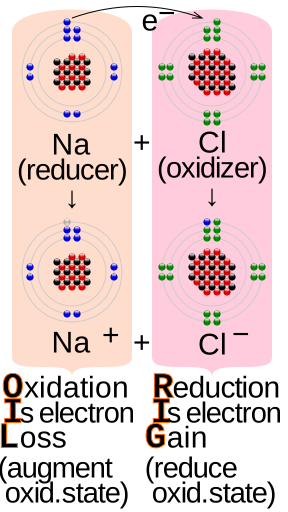
Oxidation-reduction (redox) reactions involve the transfer of electrons between species. One substance loses electrons (oxidized) while another gains electrons (reduced). These reactions are fundamental to electrochemistry, metabolism, and industrial processes.
Redox reaction showing electron transfer: oxidation (loss of e⁻) and reduction (gain of e⁻). (Wikimedia Commons)
The activity series ranks metals by their tendency to be oxidized (lose electrons). A metal higher on the series can displace a metal lower on the series from a solution of its ions.
Test your knowledge of Unit 4. Click “Show Answer” to reveal the correct choice and explanation.
1. When the equation __Fe + __O₂ → __Fe₂O₃ is balanced with the smallest whole-number coefficients, the coefficient for Fe is:
2. What is the net ionic equation for the reaction between Pb(NO₃)₂(aq) and KI(aq)?
3. Which of the following is evidence of a chemical change?
4. If 5.0 mol H₂ and 2.0 mol O₂ react according to 2H₂ + O₂ → 2H₂O, what is the theoretical yield of H₂O?
5. A student obtains 15.0 g of product in a reaction where the theoretical yield is 20.0 g. What is the percent yield?
6. 30.0 mL of 0.100 M NaOH is required to neutralize 20.0 mL of an HCl solution. What is the molarity of the HCl?
7. When solutions of Na₂CO₃ and CaCl₂ are mixed, a precipitate forms. Which compound precipitates?
8. In the reaction: Zn(s) + 2HCl(aq) → ZnCl₂(aq) + H₂(g), which species is the reducing agent?
9. What is the oxidation number of Cr in K₂Cr₂O₇?
10. According to the activity series, which of the following metals can displace Cu²⁺ from a CuSO₄ solution?
Unit 4 brings together many core skills. Make sure you can balance equations quickly, write net ionic equations (memorize the strong acids and solubility rules), and solve stoichiometry problems with limiting reagents. Practice titration calculations until they are second nature. For redox, focus on assigning oxidation numbers and identifying the oxidizing/reducing agents. These skills are essential for Units 7–9 (equilibrium, acids/bases, and electrochemistry).
Visit AP Central