While sensation (Unit 1) involves detecting raw physical energy, perception is the process of organizing and interpreting that sensory information to give it meaning. Your brain doesn't just receive data — it actively constructs your experience of the world.
Top-Down vs. Bottom-Up Processing
Bottom-Up Processing (Data-Driven): Perception starts with the sensory input — your brain builds up from the raw details. Example: reading an unfamiliar language character by analyzing each stroke.
Top-Down Processing (Concept-Driven): Perception is guided by existing knowledge, expectations, and context. Example: reading a misspelled word correctly because your brain fills in what it expects. "Th_ c_t s_t on th_ m_t" — you can read this because of top-down processing.
Gestalt Principles of Perceptual Organization
The Gestalt psychologists (early 20th century, Germany) discovered that the brain organizes sensory information into meaningful wholes. "The whole is different from the sum of its parts."
Figure-Ground: We organize visual input into a figure (the object of focus) and a ground (the background). Example: Rubin's vase illusion — you see either a vase or two faces.
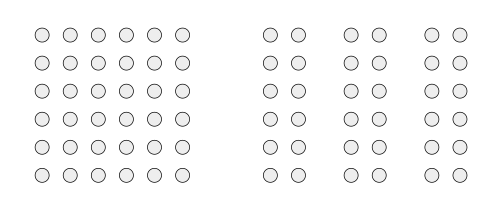
Proximity: Objects close together are perceived as a group.
Similarity: Objects that look alike are grouped together.
Continuity: We prefer smooth, continuous patterns over abrupt changes.
Closure: We fill in gaps to perceive complete figures (e.g., seeing a circle even when part is missing).
Common Fate: Objects moving in the same direction are grouped together.
Gestalt principles of perceptual organization: proximity, similarity, continuity, closure, and more (Wikimedia Commons, CC BY-SA 4.0)
Depth Perception
The ability to see objects in three dimensions and judge distances. It relies on two types of cues:
Binocular Cues (require both eyes)
Retinal Disparity: Each eye receives a slightly different image; the brain fuses these into one 3D image. Greater disparity = closer object.
Convergence: The degree to which your eyes turn inward to focus on a close object. Greater convergence = closer object.
Monocular Cues (work with one eye)
Relative Size: Smaller images are perceived as farther away.
Interposition (Overlap): Objects that block others appear closer.
Linear Perspective: Parallel lines converge in the distance.
Texture Gradient: Textures become finer and less detailed with distance.
Relative Height: Objects higher in the visual field appear farther away.
Perceptual Constancies
Size Constancy: We perceive objects as maintaining the same size even as their retinal image changes (e.g., a person walking away doesn't appear to shrink).
Shape Constancy: We perceive objects as maintaining their shape even when viewed from different angles (e.g., a door appears rectangular whether open or closed).
Color/Brightness Constancy: Perceived color and brightness remain stable despite changes in lighting conditions.
Perceptual Set
A mental predisposition to perceive things in a certain way, influenced by schemas, motivation, context, and emotion. Example: if you expect to see a snake, you're more likely to perceive a rope on a trail as a snake.
Key Takeaway: Perception is an active, constructive process. Know top-down vs. bottom-up processing, Gestalt principles, binocular/monocular depth cues, perceptual constancies, and perceptual set.
Concepts: Mental categories that group similar objects, events, or ideas. Concepts allow us to organize information efficiently without having to learn about each new thing from scratch.
Prototypes: The most typical example of a concept. When asked to think of a "bird," you're more likely to picture a robin (prototype) than a penguin. We judge new items by comparing them to our prototype.
Problem-Solving Strategies
Algorithm: A step-by-step procedure that guarantees a correct solution but can be time-consuming. Example: trying every possible combination to unlock a padlock.
Heuristic: A mental shortcut or "rule of thumb" that is faster but more error-prone. Example: searching for your keys in the places you most often leave them.
Insight: A sudden realization of a problem's solution (the "aha!" moment). Unlike algorithms or heuristics, insight arrives without a step-by-step process.
Obstacles to Problem-Solving
Fixation: An inability to see a problem from a new perspective.
Mental Set: Tendency to use solutions that worked in the past, even when they're no longer effective.
Functional Fixedness: Inability to see an object as having a function beyond its usual one. Example: not thinking to use a shoe as a hammer.
Confirmation Bias: The tendency to search for and favor information that confirms our existing beliefs while ignoring contradictory evidence.
Rubin's vase: a classic perceptual illusion demonstrating figure-ground organization and how our brain interprets ambiguous stimuli (Wikimedia Commons, Public Domain)
Judgment Heuristics and Biases
Representativeness Heuristic: Judging the likelihood of something based on how well it matches a prototype or stereotype, ignoring base rates. Example: assuming a quiet, bookish person is a librarian rather than a salesperson, despite there being far more salespeople.
Availability Heuristic: Estimating the frequency or likelihood of events based on how easily examples come to mind. Example: overestimating the risk of shark attacks after watching Jaws, because those examples are vivid and easy to recall.
Anchoring Bias: Relying too heavily on the first piece of information encountered (the "anchor") when making decisions.
Overconfidence Bias: The tendency to be more confident in our judgments and knowledge than our accuracy warrants.
Framing Effect: The way information is presented ("framed") influences decisions. People react differently to "90% survival rate" vs. "10% mortality rate," even though they're identical.
Belief Perseverance: Clinging to our beliefs even after the evidence supporting them has been disproven.
Key Takeaway: Know concepts vs. prototypes, algorithms vs. heuristics, obstacles to problem-solving (mental set, functional fixedness, confirmation bias), and the major judgment heuristics/biases (representativeness, availability, anchoring, framing).
🗃️ 2.3 Introduction to Memory
Memory is the persistence of learning over time through the processes of encoding (getting information in), storage (retaining information), and retrieval (getting information back out). It is not like a video recorder; it is a reconstructive process influenced by our beliefs, expectations, and experiences.
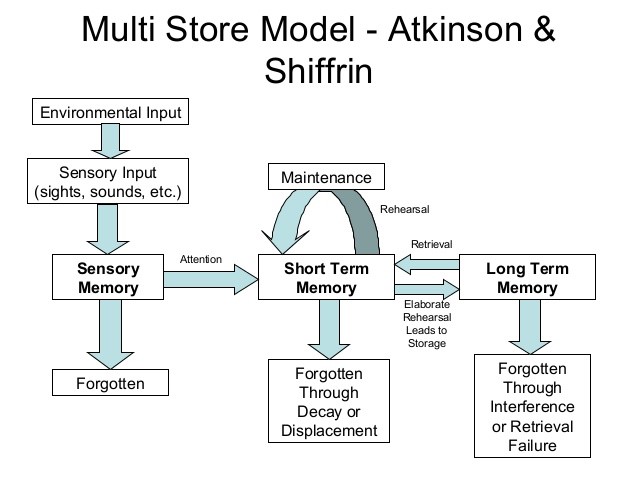
The Atkinson-Shiffrin Model (Multi-Store Model, 1968)
This foundational model describes memory as flowing through three stages:
Sensory Memory: The immediate, brief recording of sensory information. Holds vast amounts of data but for a very short time.
Short-Term Memory (STM) / Working Memory: Holds a limited amount of information (~7 ± 2 items, per George Miller) for about 20–30 seconds without rehearsal. Working memory (Alan Baddeley's model) is the active processing component of STM — it manipulates information, not just holds it.
Long-Term Memory (LTM): The relatively permanent and potentially limitless storehouse of information. Information enters LTM through rehearsal and encoding.
Types of Long-Term Memory
Explicit (Declarative) Memory: Memories you can consciously recall. Processed by the hippocampus.
Episodic Memory: Personal experiences and events ("What I had for breakfast").
Semantic Memory: General knowledge and facts ("The capital of France is Paris").
Implicit (Non-Declarative) Memory: Memories without conscious awareness. Processed by the cerebellum and basal ganglia.
Procedural Memory: Skills and habits ("How to ride a bike").
Classically Conditioned Responses: Learned associations (flinching at a dentist's office).
The Atkinson-Shiffrin Multi-Store Model showing the flow from sensory to short-term to long-term memory (Wikimedia Commons, CC BY-SA 4.0)
Automatic vs. Effortful Processing
Automatic Processing: Unconscious encoding of information without deliberate effort — time, space, frequency, and well-practiced skills. Example: remembering where you parked your car.
Effortful Processing: Requires conscious attention and deliberate effort. Example: studying vocabulary words for an AP exam.
Key Takeaway: Memory involves encoding, storage, and retrieval. The Atkinson-Shiffrin model describes three stores: sensory, short-term/working, and long-term. LTM is divided into explicit (episodic + semantic) and implicit (procedural) memory.
🔑 2.4 Encoding Memories
Encoding is the process of converting information into a form that can be stored in memory. How deeply and in what way you encode information determines how well you'll remember it later.
Levels of Processing (Craik & Lockhart, 1972)
Memory depends on the depth of processing, not just the amount of time spent studying:
Shallow Processing (Structural): Encoding based on physical features (e.g., what a word looks like, the font it's printed in). Produces weak, short-lived memories.
Intermediate Processing (Phonemic/Acoustic): Encoding based on how something sounds (e.g., rhyming). Better than shallow but not the deepest.
Deep Processing (Semantic): Encoding based on meaning. Produces the strongest, most durable memories. Example: understanding what a vocabulary word means and connecting it to your life vs. simply reading it over and over.
Effective Encoding Strategies
Elaborative Rehearsal: Connecting new information to existing knowledge, giving it meaning. Far more effective than maintenance rehearsal (simple repetition).
Chunking: Grouping individual items into larger, meaningful units to expand working memory capacity. Example: remembering 4-8-0-0-5-5-5-1-2-1-2 as 480-055-5121-2 (a phone number).
Mnemonics: Memory aids that use vivid imagery or organizational devices.
Method of Loci: Placing items to remember along a mental "walk" through a familiar place.
Peg-Word System: Associating items with a pre-memorized list of words that rhyme with numbers (one-bun, two-shoe, etc.).
Acronyms: Using the first letter of each word to form a new word (e.g., ROY G. BIV for colors of the rainbow).
Self-Referencing Effect: Information related to ourselves is encoded more deeply and remembered better.
Spacing Effect (Distributed Practice): Spreading study sessions over time is far more effective than cramming (massed practice). This is one of the most robust findings in memory research.
Testing Effect (Retrieval Practice): Actively testing yourself on material strengthens memory more than re-reading or reviewing notes.
📚 Study Hack: SQ3R Method
Survey — Skim headings
Question — Turn headings into questions
Read — Read for answers
Recite — Summarize aloud
Review — Go back over material
Combines several encoding strategies: elaborative rehearsal, self-testing, and spaced review.
Key Takeaway: Semantic (deep) encoding creates the strongest memories. Use chunking, mnemonics, elaborative rehearsal, the spacing effect, and retrieval practice for effective studying.
🗃️ 2.5 Storing Memories
Once encoded, information must be stored — maintained over time in a way that allows later retrieval. Storage involves both biological and cognitive processes.
Sensory Memory Storage
Huge capacity but very brief duration.
Iconic memory (visual): lasts about half a second. Demonstrated by George Sperling's partial-report experiments.
Echoic memory (auditory): lasts about 3–4 seconds.
Short-Term / Working Memory Storage
Capacity: approximately 7 ± 2 items (Miller's Magic Number). Can be extended by chunking.
Duration: about 20–30 seconds without rehearsal.
Baddeley's Working Memory Model expands STM into an active system with components:
Phonological Loop: Processes auditory/verbal information (inner speech).
Visuospatial Sketchpad: Processes visual and spatial information.
Central Executive: Directs attention and coordinates information between the subsystems.
Episodic Buffer: Integrates information from the subsystems and LTM into a coherent episode.
Long-Term Memory Storage
Potentially unlimited capacity and permanent duration.
Long-Term Potentiation (LTP): The biological basis of learning and memory. When neurons fire together repeatedly, the synaptic connections between them strengthen ("neurons that fire together wire together").
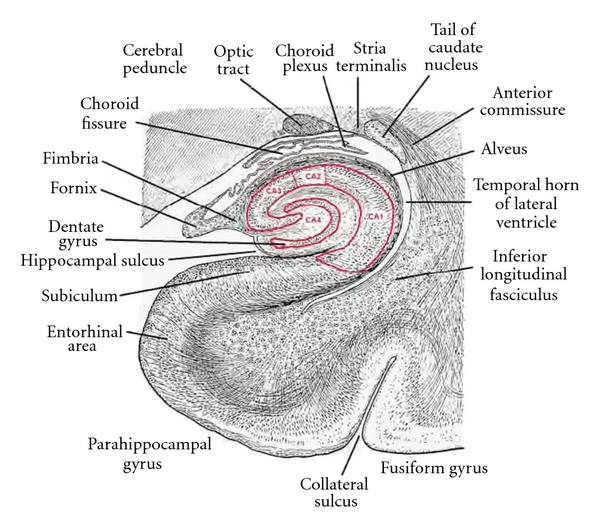
The Hippocampus is essential for consolidating short-term memories into long-term memories. It is not the final storage site — memories are eventually distributed across the cerebral cortex.
The Amygdala strengthens encoding of emotionally charged events (flashbulb memories).
The Cerebellum stores implicit procedural memories (motor skills).
The hippocampus: critical for consolidating new explicit memories into long-term storage (Wikimedia Commons, CC BY 3.0)
Serial Position Effect: When recalling a list, people tend to remember items at the beginning (primacy effect — transferred to LTM through rehearsal) and the end (recency effect — still in STM) better than items in the middle.
Key Takeaway: Memory storage varies by system: sensory memory is brief but vast, STM/working memory is limited (~7 items, ~30 sec), and LTM is potentially unlimited. Long-term potentiation is the neural basis of memory formation.
🔍 2.6 Retrieving Memories
Retrieval is the process of accessing stored information. Even if something is encoded and stored well, retrieval failure can prevent us from remembering it.
Retrieval Cues
Memories are stored in webs of associations. Retrieval works best when the right cues trigger those associations:
Recall: Retrieving information without any cues. Example: a fill-in-the-blank test. More difficult.
Recognition: Identifying previously learned information from a set of options. Example: a multiple-choice test. Easier because the answer serves as a cue.
Relearning: Learning something again after having learned it before. Even if you can't recall it, you'll relearn it faster (savings).
Context-Dependent and State-Dependent Memory
Context-Dependent Memory (Encoding Specificity Principle): Retrieval is better when you're in the same physical environment where encoding took place. Example: studying in the same room where you'll take the test.
State-Dependent Memory: Retrieval is better when your internal state (mood, physiological state) matches the state at encoding. Example: what you learn while happy is easier to recall when happy again.
Mood-Congruent Memory: The tendency to recall memories that are consistent with your current mood. When sad, you're more likely to recall sad memories.
Priming
The activation of particular associations in memory. Exposure to one stimulus influences the response to a subsequent stimulus — even without conscious awareness. Example: seeing the word "nurse" makes you faster to recognize the word "doctor."
Key Takeaway: Retrieval depends on cues. Know recall vs. recognition vs. relearning, context- and state-dependent memory, mood-congruent memory, and priming.
🚫 2.7 Forgetting and Other Memory Challenges
Forgetting is a normal and often adaptive process. Understanding why we forget is as important as understanding how we remember.
Theories of Forgetting
Encoding Failure: Information was never properly encoded in the first place — it didn't make it into long-term memory. Example: not remembering the details on a penny because you never encoded them.
Storage Decay: Memories fade over time if not accessed. Ebbinghaus's Forgetting Curve (1885) showed that forgetting is rapid at first and then levels off. Regularly reviewing material counteracts decay.
Retrieval Failure (Tip-of-the-Tongue): The information is stored but temporarily inaccessible. Often triggered by insufficient retrieval cues.
Interference:
Proactive Interference:Old information blocks learning of new information. Example: your old phone number interferes with remembering your new one. (Pro = forward; old interferes going forward.)
Retroactive Interference:New information blocks recall of old information. Example: learning your new password makes it hard to recall the old one. (Retro = backward; new interferes going backward.)
Motivated Forgetting (Repression): Freud proposed that the mind protects itself by pushing threatening or painful memories into the unconscious. This concept is controversial in modern psychology.
Memory Distortion and Construction
Misinformation Effect (Elizabeth Loftus): After witnessing an event, exposure to misleading information can distort a person's memory. In Loftus's classic studies, changing one word in a question ("How fast were the cars going when they smashed vs. hit each other?") significantly altered speed estimates and false memories of broken glass.
Source Monitoring Error (Source Amnesia): Attributing a memory to the wrong source. Example: remembering a piece of information but forgetting whether you heard it on the news or from a friend.
False Memories: Memories of events that never occurred, often created through suggestion, imagination, or repeated exposure to misinformation. The "lost in the mall" study demonstrated how easily false memories can be implanted.
Ebbinghaus's Forgetting Curve: memory retention drops rapidly at first, then levels off. Spaced review combats this decline (Wikimedia Commons, Public Domain)
Key Takeaway: We forget due to encoding failure, decay, interference (proactive vs. retroactive), and retrieval failure. Memories can be distorted by the misinformation effect, source monitoring errors, and false memory implantation.
📈 2.8 Intelligence and Achievement
Intelligence is the ability to learn from experience, solve problems, and use knowledge to adapt to new situations. Psychologists have debated whether intelligence is one general ability or multiple distinct abilities.
Theories of Intelligence
Charles Spearman — General Intelligence (g factor): Intelligence is a single, underlying mental ability that influences all intellectual tasks. People who score high on one cognitive test tend to score high on others.
Howard Gardner — Multiple Intelligences (1983): Intelligence comes in at least 8 independent forms: linguistic, logical-mathematical, musical, spatial, bodily-kinesthetic, interpersonal, intrapersonal, and naturalist. Critics argue these may be talents rather than intelligences.
Robert Sternberg — Triarchic Theory (1985): Three aspects of intelligence:
Creative: Generating novel ideas and adapting to new situations.
Practical: Everyday "street smarts" and the ability to manage daily tasks effectively.
Emotional Intelligence (Salovey & Mayer; popularized by Goleman): The ability to perceive, understand, manage, and use emotions effectively in oneself and others.
Intelligence Testing
Alfred Binet & Theodore Simon (1905): Created the first modern intelligence test to identify students needing academic help. Introduced the concept of mental age.
Lewis Terman (Stanford-Binet): Adapted Binet's test for American use. Introduced the Intelligence Quotient (IQ) = (mental age / chronological age) × 100.
David Wechsler (WAIS, WISC): Created the most widely used intelligence tests today. The Wechsler tests provide separate scores for verbal comprehension, perceptual reasoning, working memory, and processing speed, as well as an overall IQ.
IQ scores follow a normal distribution (bell curve): mean = 100, standard deviation = 15. About 68% of people score between 85 and 115.
The normal distribution of IQ scores: mean of 100, standard deviation of 15 (Wikimedia Commons, CC BY-SA 3.0)
Qualities of a Good Test
Standardization: The test is administered under uniform conditions and scores are compared to a representative sample (norms).
Reliability: The test yields consistent results over time (test-retest reliability) or across different forms (split-half reliability).
Validity: The test measures what it claims to measure.
Content Validity: The test covers the full range of the concept being measured.
Predictive Validity (Criterion Validity): The test predicts future performance (e.g., SAT scores predicting college GPA).
Nature, Nurture, and Group Differences in Intelligence
Heritability of intelligence is estimated at around 50–80% in twin studies, but this applies to variation within a population, not to individuals.
Environment matters enormously: nutrition, education, socioeconomic status, and early childhood stimulation all affect cognitive development.
Flynn Effect: Average IQ scores have been rising over generations (about 3 points per decade), likely due to improved nutrition, education, and environmental stimulation.
Stereotype Threat (Claude Steele): When individuals are aware of a negative stereotype about their group, anxiety about confirming the stereotype can impair their performance on tests.
Test Bias: A test may be culturally biased if it reflects the values and experiences of one cultural group more than others, disadvantaging certain test-takers.
Growth vs. Fixed Mindset (Carol Dweck)
Fixed Mindset: Believing intelligence is a static, unchangeable trait. Leads to avoidance of challenges and giving up easily.
Growth Mindset: Believing intelligence can be developed through effort, learning, and persistence. Leads to embracing challenges and resilience.
Key Takeaway: Know the major theories of intelligence (Spearman, Gardner, Sternberg), key test creators (Binet, Terman, Wechsler), qualities of good tests (standardization, reliability, validity), the Flynn effect, and stereotype threat.
📚 Important Vocabulary
Term
Definition
Perception
The process of organizing and interpreting sensory information to give it meaning.
Top-Down Processing
Perception guided by existing knowledge, expectations, and context rather than raw sensory data.
Bottom-Up Processing
Perception built from raw sensory data without prior knowledge; data-driven.
Gestalt Principles
Rules describing how the brain groups sensory elements into meaningful patterns (proximity, similarity, closure, continuity, figure-ground).
Retinal Disparity
A binocular depth cue based on the slight difference between the images received by each eye.
Perceptual Constancy
The tendency to perceive objects as stable and unchanging despite changes in sensory input (size, shape, color).
Perceptual Set
A mental predisposition to perceive things in a certain way, influenced by expectations and context.
Concept
A mental category used to group similar objects, events, or ideas.
Prototype
The most typical example of a particular concept or category.
Algorithm
A step-by-step problem-solving procedure that guarantees a correct solution.
Heuristic
A mental shortcut that enables quick but sometimes error-prone judgments and decisions.
Confirmation Bias
The tendency to seek and favor information that confirms existing beliefs.
Availability Heuristic
Estimating the likelihood of events based on how easily examples come to mind.
Representativeness Heuristic
Judging the likelihood of something by how well it matches a prototype, often ignoring base rates.
Framing Effect
The way a question or issue is presented (framed) influences decisions and judgments.
Functional Fixedness
The inability to see an object as having a use beyond its typical function; an obstacle to problem-solving.
Encoding
The process of converting information into a form that can be stored in memory.
Storage
The retention of encoded information over time.
Retrieval
The process of accessing stored information from memory.
Sensory Memory
The immediate, very brief recording of sensory information (iconic = visual; echoic = auditory).
Working Memory
An active system for temporarily holding and manipulating information; an expansion of the STM concept.
Long-Term Potentiation (LTP)
The strengthening of synaptic connections through repeated stimulation; the neural basis of learning and memory.
Explicit Memory
Conscious memories of facts (semantic) and personal experiences (episodic); depends on the hippocampus.
Implicit Memory
Unconscious memories including skills, habits, and conditioned responses; depends on cerebellum/basal ganglia.
Chunking
Organizing items into familiar, manageable units to expand working memory capacity.
Spacing Effect
The finding that distributed practice over time yields better long-term retention than massed practice (cramming).
Serial Position Effect
The tendency to recall the first (primacy) and last (recency) items in a list better than the middle items.
Proactive Interference
Old information interferes with the ability to learn or recall new information.
Retroactive Interference
New information interferes with the ability to recall previously learned information.
Misinformation Effect
Misleading information presented after an event can alter a person's memory of that event (Elizabeth Loftus).
Source Amnesia
Attributing a memory to the wrong source; misremembering where or how you learned something.
g Factor (General Intelligence)
Spearman's concept of a single underlying general intelligence that influences performance on all cognitive tasks.
Standardization
Administering a test using uniform procedures and comparing scores against established norms.
Reliability
The consistency of a test's results across repeated administrations or different forms.
Validity
The degree to which a test measures what it claims to measure (content validity, predictive validity).
Flynn Effect
The observed rise in average IQ scores over successive generations.
Stereotype Threat
Anxiety about confirming a negative stereotype that can impair performance on tests (Claude Steele).
Growth Mindset
Carol Dweck's concept that intelligence and abilities can be developed through effort and learning.
✍️ Practice Multiple-Choice Questions
Test your knowledge with 25 AP-style questions. Click "Show Answer" to reveal the correct answer and explanation.
1. A person reads "I luv NY" and understands it as "I love New York" despite the unconventional spelling. This is an example of:
A) Bottom-up processing
B) Sensory adaptation
C) Top-down processing
D) Signal detection
Answer: C) Top-down processing uses existing knowledge and context to interpret sensory input, allowing you to understand the message despite its unconventional form.
2. The Gestalt principle of closure is best demonstrated by:
A) Seeing rows of dots arranged close together as belonging to the same group
B) Perceiving a complete circle even though part of it is missing
C) Viewing two overlapping squares and perceiving the front one as closer
D) Grouping red shapes together separately from blue shapes
Answer: B) Closure is the Gestalt principle where we fill in gaps to perceive incomplete figures as complete wholes.
3. An artist holds up their thumb at arm's length to judge the size of a distant building. This technique relies on which monocular depth cue?
A) Convergence
B) Retinal disparity
C) Relative size
D) Linear perspective
Answer: C) Relative size is a monocular cue where smaller images are perceived as farther away. By comparing the thumb to the building, the artist uses this cue to estimate size and distance.
4. A student who cannot figure out how to use a textbook as a doorstop is demonstrating:
A) Confirmation bias
B) The availability heuristic
C) Functional fixedness
D) The representativeness heuristic
Answer: C) Functional fixedness is the inability to see an object as serving a function other than its typical use. The student only sees the textbook as something to read.
5. After a plane crash receives extensive media coverage, people overestimate the danger of flying compared to driving. This best illustrates the:
A) Framing effect
B) Representativeness heuristic
C) Belief perseverance
D) Availability heuristic
Answer: D) The availability heuristic leads people to judge the frequency or probability of events based on how easily examples come to mind. Vivid media coverage makes plane crashes highly available in memory.
6. In the Atkinson-Shiffrin model, information must pass through which store before entering long-term memory?
A) Procedural memory
B) Episodic memory
C) Short-term/working memory
D) The central executive
Answer: C) The Atkinson-Shiffrin model proposes that information flows from sensory memory to short-term/working memory to long-term memory. Rehearsal and encoding in STM are required for transfer to LTM.
7. George Miller's "magic number" refers to the capacity of short-term memory, which is approximately:
A) 3 ± 1 items
B) 5 ± 1 items
C) 7 ± 2 items
D) 12 ± 3 items
Answer: C) Miller's research showed that short-term memory can hold approximately 7 ± 2 items (5 to 9 chunks of information) at one time.
8. Which type of long-term memory stores personal experiences and events?
A) Semantic memory
B) Procedural memory
C) Episodic memory
D) Implicit memory
Answer: C) Episodic memory is a type of explicit (declarative) memory that stores personal experiences and specific events, including the time, place, and emotions associated with them.
9. According to the levels of processing framework, which encoding method would produce the best long-term retention?
A) Reading the word's definition aloud repeatedly
B) Counting the number of vowels in each vocabulary word
C) Writing each word in a different color
D) Creating a sentence using the word that relates to your personal life
Answer: D) Deep semantic processing (creating meaningful connections, especially self-referencing) produces the strongest and most durable memories, according to Craik and Lockhart's levels of processing theory.
10. The spacing effect suggests that students who want to maximize retention should:
A) Study intensively the night before an exam
B) Study in multiple short sessions spread over days or weeks
C) Study in one long session without breaks
D) Review material only once and rely on recognition
Answer: B) The spacing effect is one of the most robust findings in memory research: distributed practice (spreading study over time) leads to much better long-term retention than massed practice (cramming).
11. Long-term potentiation (LTP) refers to:
A) The tendency of memories to improve over time
B) The strengthening of synaptic connections through repeated stimulation
C) The brain's ability to store unlimited information
D) The conversion of implicit memories into explicit memories
Answer: B) LTP is the neural basis of learning and memory. When neurons repeatedly fire together, the synaptic connections between them strengthen, making future transmission easier.
12. A student does well on a multiple-choice test but poorly on an essay exam covering the same material. This difference is best explained by the distinction between:
A) Semantic and episodic memory
B) Implicit and explicit memory
C) Recognition and recall
D) Proactive and retroactive interference
Answer: C) Multiple-choice tests rely on recognition (identifying correct answers from options), while essays require recall (retrieving information without cues). Recognition is generally easier.
13. Maria studied French in high school. Now in college, she is learning Spanish but keeps accidentally using French words. This is an example of:
A) Retroactive interference
B) Proactive interference
C) Source amnesia
D) Encoding failure
Answer: B) Proactive interference occurs when previously learned information (French) interferes with the ability to learn or recall new information (Spanish). "Pro" = old information interfering forward.
14. Elizabeth Loftus's research on the misinformation effect demonstrated that:
A) Eyewitness memories are generally accurate and reliable
B) Leading questions and post-event information can alter a person's memory
C) Repressed memories can always be accurately recovered
D) Short-term memory has a limited capacity
Answer: B) Loftus's research showed that misleading post-event information (like changing a word in a question) can distort eyewitness memories, demonstrating that memory is reconstructive and susceptible to suggestion.
15. According to Ebbinghaus's forgetting curve, the greatest amount of forgetting occurs:
A) Gradually and steadily over weeks
B) Rapidly within the first hours and days after learning
C) Only after several months of not reviewing
D) Equally at all time intervals
Answer: B) Ebbinghaus found that forgetting is rapid at first (most memory loss happens in the first hours and days), then the rate of forgetting slows and levels off over time.
16. Howard Gardner's theory of multiple intelligences proposes that:
A) Intelligence is a single general ability measured by IQ tests
B) There are three types of intelligence: analytical, creative, and practical
C) Intelligence consists of multiple independent abilities, including musical and interpersonal
D) Emotional intelligence is the most important form of intelligence
Answer: C) Gardner proposed at least 8 distinct, independent intelligences (linguistic, logical-mathematical, musical, spatial, bodily-kinesthetic, interpersonal, intrapersonal, naturalist), challenging the idea of a single g factor.
17. A test that consistently produces the same scores when taken by the same person at different times demonstrates high:
A) Validity
B) Standardization
C) Reliability
D) Content validity
Answer: C) Reliability refers to the consistency of test results over time (test-retest reliability). A reliable test yields similar scores on repeated administrations.
18. The Flynn Effect refers to the observation that:
A) IQ scores have been declining over generations
B) Intelligence is entirely determined by genetics
C) Average IQ scores have been rising over generations
D) Men consistently score higher than women on IQ tests
Answer: C) The Flynn Effect is the well-documented finding that average IQ scores have been rising about 3 points per decade, likely due to improved nutrition, education, and environmental stimulation.
19. Claude Steele's research on stereotype threat showed that:
A) Stereotypes have no effect on test performance
B) Awareness of negative stereotypes about one's group can impair performance
C) Intelligence tests are always culturally biased
D) Women outperform men on all cognitive tasks
Answer: B) Stereotype threat occurs when individuals are aware of a negative stereotype about their group, creating anxiety that can undermine their performance on the task, even if the stereotype is inaccurate.
20. A doctor chooses surgery for a patient after being told "the surgery has a 90% survival rate" but refuses it when told "the surgery has a 10% mortality rate." This best illustrates the:
A) Anchoring bias
B) Confirmation bias
C) Framing effect
D) Overconfidence bias
Answer: C) The framing effect occurs when the way information is presented influences decision-making. "90% survival" and "10% mortality" are statistically identical, but the positive frame leads to a different decision.
21. Studying for a test in the same room where you will take the test may improve performance due to:
A) The spacing effect
B) State-dependent memory
C) Context-dependent memory
D) The testing effect
Answer: C) Context-dependent memory (encoding specificity principle) suggests that retrieval is enhanced when the physical environment at retrieval matches the environment at encoding.
22. Iconic memory is to echoic memory as:
A) Short-term is to long-term
B) Visual is to auditory
C) Explicit is to implicit
D) Semantic is to episodic
Answer: B) Iconic memory is the sensory memory for visual information (lasts ~0.5 seconds), while echoic memory is the sensory memory for auditory information (lasts ~3-4 seconds).
23. Remembering how to ride a bicycle is an example of:
A) Episodic memory
B) Semantic memory
C) Procedural (implicit) memory
D) Sensory memory
Answer: C) Procedural memory is a type of implicit (non-declarative) memory that stores skills and habits, like riding a bicycle. It operates without conscious awareness.
24. Robert Sternberg's triarchic theory includes which three types of intelligence?
A) Verbal, mathematical, and spatial
B) Analytical, creative, and practical
C) Interpersonal, intrapersonal, and naturalist
D) Fluid, crystallized, and emotional
Answer: B) Sternberg's triarchic theory proposes three aspects of intelligence: analytical (academic problem-solving), creative (novel thinking), and practical (everyday "street smarts").
25. Priming is best described as:
A) Consciously rehearsing information to move it into long-term memory
B) The activation of associations in memory by exposure to a related stimulus
C) Organizing information into smaller, meaningful units
D) The tendency to recall the first and last items in a list
Answer: B) Priming is the implicit activation of associations in memory. Exposure to one stimulus (e.g., "bread") makes it easier to recognize or respond to a related stimulus (e.g., "butter").