Social psychology studies how individuals think about, influence, and relate to one another. A core question is: Why did that person do what they did? The explanations we create are called attributions.
Types of Attributions
Dispositional (Internal) Attribution: Explaining someone's behavior as caused by their personality, character, or ability. Example: "She got an A because she's smart."
Situational (External) Attribution: Explaining someone's behavior as caused by the situation or environment. Example: "She got an A because the test was easy."
Key Attribution Biases and Errors
Bias / Error
Description
Example
Fundamental Attribution Error (FAE)
Tendency to overestimate dispositional factors and underestimate situational factors when explaining others' behavior.
Assuming a quiet classmate is shy (dispositional), when they may just be having a bad day (situational).
Actor–Observer Bias
Tendency to attribute our own behavior to situational factors but others' behavior to dispositional factors.
"I failed because the test was unfair" vs. "He failed because he didn't study."
Self-Serving Bias
Tendency to attribute our successes to dispositional factors and our failures to situational factors.
"I aced the test because I'm smart" but "I failed because the teacher is terrible."
Just-World Hypothesis
Belief that the world is fair and people get what they deserve, leading to victim-blaming.
Assuming someone who was robbed must have been careless.
Person Perception
We form impressions of others rapidly, often based on limited information:
Primacy Effect: First impressions carry disproportionate weight. Information presented first has the greatest influence on our overall impression.
Halo Effect: One positive trait (e.g., attractiveness) leads us to assume other positive qualities (e.g., intelligence, kindness).
Self-Fulfilling Prophecy: Our expectations about a person can influence how we treat them, causing them to behave in ways that confirm our expectations. Rosenthal & Jacobson's "Pygmalion in the Classroom" study demonstrated that teachers' expectations influenced student performance.
Stereotypes, Prejudice, and Discrimination
Stereotype: A generalized belief about a group of people (cognitive component). Can be positive or negative.
Prejudice: An unjustifiable negative attitude toward a group and its members (affective component).
Discrimination: Unjustifiable negative behavior toward a group and its members (behavioral component).
Implicit Bias: Unconscious attitudes that affect behavior without conscious awareness. Measured by the Implicit Association Test (IAT).
In-Group / Out-Group: We favor members of our own group (in-group bias) and may view out-group members as more similar to each other than they actually are (out-group homogeneity bias).
Key Takeaway: Attribution theory explains how we assign causes to behavior. The fundamental attribution error is one of the most robust findings in social psychology — we consistently overestimate personality and underestimate situational factors when judging others.
💡 4.2 Attitude Formation and Attitude Change
An attitude is a learned predisposition to respond positively or negatively toward a particular object, person, or idea. Attitudes have three components (the ABC model):
Affective: How you feel about the object (emotions).
Behavioral: How you act toward the object.
Cognitive: What you think/believe about the object.
How Attitudes Form
Direct Experience: Personal encounters shape attitudes most powerfully.
Observational Learning: Watching others (parents, peers, media) form attitudes.
Classical Conditioning: Pairing a neutral object with something that evokes emotion.
Operant Conditioning: Attitudes reinforced by rewards or punished by social disapproval.
Cognitive Dissonance Theory (Leon Festinger, 1957)
We experience psychological discomfort when we hold two contradictory cognitions (beliefs, attitudes, or behaviors) simultaneously. To reduce this tension, we change one of the cognitions — often adjusting our attitude to match our behavior.
Classic Study: Festinger & Carlsmith (1959) — Participants paid $1 (vs. $20) to tell the next participant that a boring task was enjoyable. The $1 group reported actually enjoying the task more, because they needed to justify their lie with insufficient external reward.
Reducing Dissonance: Change the behavior, change the attitude, add new cognitions, or trivialize the inconsistency.
Cognitive Dissonance: When beliefs and behavior conflict, we change one to restore consistency. (Wikimedia Commons, CC BY-SA 3.0)
Persuasion: The Elaboration Likelihood Model (Petty & Cacioppo)
Two routes to persuasion explain how attitudes change:
Central Route Occurs when people think carefully about the content of the message. Requires motivation and ability. Leads to longer-lasting attitude change.
Example: Reading a detailed policy proposal before voting.
Peripheral Route Occurs when people are influenced by superficial cues — attractiveness of the speaker, celebrity endorsements, emotional appeals. Leads to temporary, weaker attitude change.
Example: Buying a product because a famous athlete endorses it.
Foot-in-the-Door and Door-in-the-Face
Foot-in-the-Door: Start with a small request; once agreed, follow with a larger request. People who comply with the small request are more likely to comply with the big one (consistency principle).
Door-in-the-Face: Start with an unreasonably large request (expected to be refused), then follow with a smaller, more reasonable request. The contrast makes the second request seem modest.
Key Takeaway: Cognitive dissonance theory and the elaboration likelihood model are the two most tested attitude-change concepts on the AP exam. Remember: the central route = logic/thinking; the peripheral route = surface cues/emotions.
👥 4.3 Psychology of Social Situations
Social situations exert powerful influence over individual behavior. This topic covers conformity, obedience, group dynamics, aggression, and prosocial behavior.
Conformity
Conformity is adjusting one's behavior or thinking to match a group standard. Two key types:
Normative Social Influence: Conforming to be accepted or avoid rejection. Driven by the desire to belong.
Informational Social Influence: Conforming because we believe the group knows better, especially in ambiguous situations.
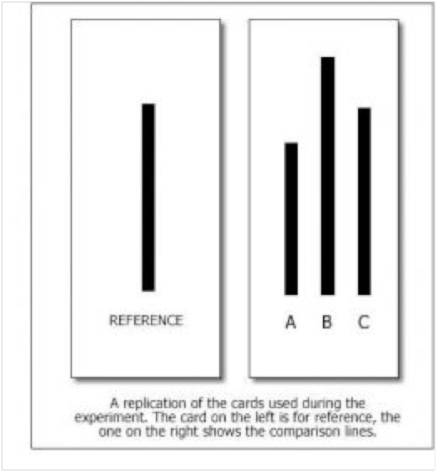
Asch's Conformity Experiment (1951): Participants were shown a standard line and asked which of three comparison lines matched. Confederate participants gave obviously wrong answers. About 75% of participants conformed at least once; the average conformity rate was about 37%. Conformity increased with group size (up to a point) and unanimity.
Asch's line judgment task: Which comparison line (A, B, or C) matches the standard? (Wikimedia Commons, Free Art License)
Obedience
Obedience is complying with direct commands from an authority figure.
Milgram's Obedience Experiment (1963): Participants were instructed by an experimenter to administer increasingly intense electric shocks to a "learner" (actually a confederate). 65% of participants delivered the maximum 450-volt shock, despite the learner's screams and protests.
Factors that increased obedience:
Authority figure physically present and perceived as legitimate
Victim in a separate room (distance from the victim)
Authority figure absent or giving instructions by phone
Victim in the same room or requiring physical contact
Two experimenters giving contradictory orders
Other participants refusing to comply
Milgram's obedience setup: The experimenter (E) orders the teacher (T) to shock the learner (L). (Wikimedia Commons, CC BY-SA 3.0)
Group Dynamics
Concept
Description
Social Facilitation
Tendency to perform better on simple/well-practiced tasks and worse on complex/unfamiliar tasks in the presence of others.
Social Loafing
Tendency to exert less effort when working in a group than when working alone. Individuals feel less personally accountable.
Deindividuation
Loss of self-awareness and individual accountability in group situations, often leading to impulsive or deviant behavior (e.g., mob behavior, online anonymity).
Group Polarization
Group discussion tends to strengthen the pre-existing attitudes of group members, pushing them toward more extreme positions.
Groupthink
Desire for harmony in a group overrides realistic appraisal of alternatives. Results in poor decision-making. (Janis, 1972 — e.g., Bay of Pigs invasion.)
Aggression
Biological Factors: Genetics, testosterone levels, amygdala activation, low serotonin, and neural damage can contribute to aggressive behavior.
Psychological Factors: The frustration-aggression hypothesis proposes that frustration (blocking of goal-directed behavior) creates anger, which can generate aggression.
Social Learning: Bandura's research shows aggression can be learned through observation and imitation (Bobo doll experiment, covered in Unit 3).
Prosocial Behavior and Altruism
Altruism: Unselfish regard for the welfare of others.
Bystander Effect: The more bystanders present, the less likely any one person is to help. Driven by diffusion of responsibility (Darley & Latané, 1968 — inspired by the Kitty Genovese case).
Social Exchange Theory: Our social behavior is a cost-benefit analysis — we help when the benefits outweigh the costs.
Reciprocity Norm: We should return help to those who have helped us.
Social Responsibility Norm: We should help those who need help, even without expectation of future payback.
Key Takeaway: Social situations powerfully shape behavior. Asch showed conformity to group pressure; Milgram showed obedience to authority. The bystander effect, groupthink, and deindividuation all demonstrate that context — not just personality — drives action.
💬 4.4 Psychodynamic and Humanistic Theories of Personality
Personality is an individual's characteristic pattern of thinking, feeling, and acting. This topic covers two major theoretical perspectives: psychodynamic and humanistic.
Freud's Psychoanalytic Theory
Sigmund Freud (1856–1939) proposed that personality is shaped largely by unconscious forces — desires, memories, and conflicts hidden from conscious awareness.
The rational mediator between the id and reality. Operates in the conscious and unconscious mind. Finds realistic ways to satisfy the id.
Superego
Morality principle
Internalized moral standards and ideals from parents and society. Strives for perfection; produces guilt.
Psychosexual Stages
Freud believed personality develops through five stages. Unresolved conflict at any stage causes fixation:
Stage
Age
Focus
Oral
0–18 months
Pleasure from mouth (sucking, biting). Fixation → smoking, overeating.
Anal
18–36 months
Pleasure from bowel control. Fixation → orderliness or messiness.
Phallic
3–6 years
Pleasure from genitals. Oedipus/Electra complex. Fixation → vanity or recklessness.
Latency
6–puberty
Dormant sexual feelings. Focus on social and intellectual skills.
Genital
Puberty onward
Mature sexual interests. Healthy adults channel libido into relationships and work.
Sigmund Freud (c. 1921), the founder of psychoanalysis. Photo by Max Halberstadt. (Wikimedia Commons, Public Domain)
Defense Mechanisms
The ego protects itself from anxiety using unconscious strategies called defense mechanisms:
Defense Mechanism
Description
Example
Repression
Pushing threatening thoughts into the unconscious.
Forgetting a traumatic childhood event.
Denial
Refusing to accept reality.
An alcoholic insisting they don't have a problem.
Projection
Attributing your own unacceptable feelings to others.
A jealous person accusing their partner of jealousy.
Rationalization
Creating logical excuses for irrational behavior.
"I didn't want that job anyway."
Displacement
Redirecting emotions to a safer target.
Yelling at your dog after a bad day at work.
Sublimation
Channeling unacceptable impulses into socially acceptable activities.
Aggressive urges channeled into competitive sports.
Regression
Reverting to an earlier stage of development.
An adult throwing a tantrum when stressed.
Reaction Formation
Behaving in a way opposite to one's true feelings.
Being overly nice to someone you dislike.
Neo-Freudian Theorists
Carl Jung: Proposed the collective unconscious — shared, inherited reservoir of memory traces from our species' history, containing universal archetypes (e.g., the Hero, the Shadow, the Anima/Animus).
Alfred Adler: Emphasized inferiority complex and striving for superiority. Focused on social factors rather than sexual ones.
Karen Horney: Challenged Freud's views on women (e.g., "penis envy"). Emphasized basic anxiety — a child's sense of helplessness in a hostile world — as a primary motivator.
Erik Erikson: Extended Freud's stages across the entire lifespan with his 8 psychosocial stages (covered in Unit 3), emphasizing social relationships over sexual drives.
Humanistic Theories of Personality
Humanistic psychology emerged as a reaction against both psychoanalysis and behaviorism, focusing on personal growth, free will, and human potential.
Abraham Maslow (1908–1970)
Proposed a hierarchy of needs: physiological → safety → belongingness → esteem → self-actualization.
Self-actualization: Achieving one's full potential and living a meaningful, creative life.
Studied peak experiences — moments of awe, wonder, and transcendence reported by self-actualized individuals.
Carl Rogers (1902–1987)
Emphasized the self-concept — our overall perception of who we are.
Unconditional Positive Regard: Accepting and valuing a person regardless of their behavior. Rogers believed this was essential for healthy personality development.
Conditions of Worth: When love and acceptance are contingent on meeting certain standards, the person develops a distorted self-concept.
Congruence: When the real self (who you are) matches the ideal self (who you want to be), a person is well-adjusted and authentic.
Maslow's Hierarchy of Needs: Basic needs must be met before higher-level growth needs. (Wikimedia Commons, CC BY-SA 3.0)
Key Takeaway: Freud emphasized unconscious conflicts and defense mechanisms; humanists like Maslow and Rogers emphasized growth, self-actualization, and unconditional positive regard. Know all 8 defense mechanisms and Freud's three personality structures (id, ego, superego) for the AP exam.
📈 4.5 Social-Cognitive and Trait Theories of Personality
While psychodynamic and humanistic theories focus on internal dynamics, trait theories describe personality using measurable characteristics, and social-cognitive theories emphasize the interaction between thoughts, behavior, and environment.
Trait Theories
Trait theorists seek to describe personality by identifying stable patterns of behavior called traits.
Gordon Allport (1897–1967)
One of the first trait theorists. Identified three levels: cardinal traits (rare, dominant traits that define a person), central traits (general characteristics that form the foundation of personality), and secondary traits (situation-specific preferences).
Raymond Cattell (1905–1998)
Used factor analysis to reduce Allport's long list to 16 personality factors, measured by the 16PF Questionnaire.
Hans Eysenck (1916–1997)
Reduced personality to just two (later three) dimensions: introversion-extraversion and neuroticism-stability (later adding psychoticism).
The Big Five (OCEAN) — Costa & McCrae
The most widely accepted trait model today. Five broad dimensions:
Factor
High Scorers
Low Scorers
Openness
Curious, imaginative, open to new experiences
Conventional, down-to-earth, narrow interests
Conscientiousness
Organized, disciplined, dependable
Careless, impulsive, disorganized
Extraversion
Sociable, energetic, talkative
Reserved, quiet, solitary
Agreeableness
Trusting, cooperative, helpful
Suspicious, competitive, antagonistic
Neuroticism
Anxious, moody, emotionally unstable
Calm, secure, emotionally stable
The Big Five (OCEAN) personality traits model. (Wikimedia Commons, CC BY-SA 4.0)
Social-Cognitive Theories
Social-cognitive theorists emphasize the interaction between traits, thinking patterns, and the social environment.
Albert Bandura — Reciprocal Determinism
Personality results from the continuous interaction of three factors: behavior, cognitive/personal factors (thoughts, beliefs, expectations), and the environment. Each influences the other two.
Self-Efficacy: A person's belief in their ability to succeed in a specific situation. High self-efficacy leads to greater motivation and persistence.
Julian Rotter — Locus of Control
Internal Locus of Control: Belief that you control your own outcomes. Associated with greater academic success and lower stress.
External Locus of Control: Belief that outside forces (luck, fate, others) control your outcomes.
Martin Seligman — Learned Helplessness
When people feel they have no control over their situation, they may give up trying — even when escape is possible (also covered in Unit 3).
Personality Assessment
Type
Example
Description
Self-Report Inventories
MMPI-2, NEO-PI-R, 16PF
Standardized questionnaires. Objective and reliable but susceptible to social desirability bias.
Projective Tests
Rorschach Inkblot Test, TAT
Ambiguous stimuli that supposedly reveal unconscious thoughts. Low reliability and validity.
Key Takeaway: The Big Five (OCEAN) is the most empirically supported trait model. Bandura's reciprocal determinism and concepts of self-efficacy and locus of control are essential social-cognitive concepts for the AP exam.
🎯 4.6 Motivation
Motivation is a need or desire that energizes and directs behavior. Psychologists study why we do what we do.
Major Theories of Motivation
Theory
Key Idea
Details
Instinct Theory
Innate, fixed patterns of behavior
Early approach inspired by Darwin. Criticized for merely labeling behaviors as "instincts" without explaining them.
Drive-Reduction Theory
Physiological needs create arousal (drives) that motivate behavior to restore homeostasis.
Hunger creates a drive to eat; eating reduces the drive. Primary drives (biological) vs. secondary drives (learned, like money).
Arousal Theory
We seek an optimal level of arousal.
Too little arousal → boredom → seek stimulation. Too much arousal → anxiety → seek calm. Explains sensation-seeking behavior.
Set-Point Theory: The body has a natural weight "thermostat" and adjusts metabolism to maintain it.
Psychological & Social Factors: Stress eating, unit bias (eating what's on your plate), cultural norms, food availability, and social influence all affect eating behavior.
Sexual Motivation
Influenced by biological factors (hormones like testosterone and estrogen), psychological factors (fantasies, desires), and social/cultural factors (norms, values).
Masters & Johnson (1966): Described the human sexual response cycle: excitement → plateau → orgasm → resolution (with a refractory period in males).
Achievement Motivation
Need for Achievement (nAch): A drive to accomplish difficult tasks and meet high standards of excellence (McClelland).
Grit: Passion and perseverance for long-term goals (Angela Duckworth). Predicts success beyond IQ.
Key Takeaway: Multiple theories explain motivation — from biological drives to cognitive expectations. The Yerkes-Dodson Law, Maslow's hierarchy, and the distinction between intrinsic and extrinsic motivation are high-frequency AP exam topics.
🎨 4.7 Emotion
Emotion involves a subjective experience (feeling), physiological arousal (body response), and behavioral expression (observable actions). The central debate: What comes first — the feeling or the body response?
Major Theories of Emotion
Theory
Key Idea
Sequence
James-Lange Theory
We experience emotion because of our physiological arousal.
Event → Physiological response → Cognitive interpretation → Emotion "My heart is racing — I must be excited!"
Lazarus's Cognitive Appraisal Theory
Cognitive appraisal precedes both emotion and arousal.
Event → Cognitive appraisal → Emotion + Physiological response "I think this is dangerous — now I feel afraid."
Zajonc's Theory (Mere Exposure)
Some emotional reactions require no conscious thought; emotions can precede cognition.
Event → Emotion (without conscious processing) "I just like it — no reason needed."
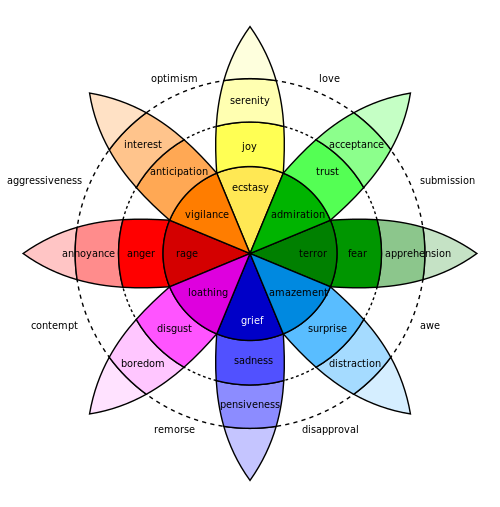
Plutchik's Wheel of Emotions: 8 basic emotions arranged by intensity and opposites. (Wikimedia Commons, CC BY-SA 4.0)
The Autonomic Nervous System and Emotion
The sympathetic nervous system activates the "fight-or-flight" response: increased heart rate, dilated pupils, rapid breathing, sweating.
The parasympathetic nervous system calms the body after the threat passes: "rest-and-digest."
The amygdala is the brain's emotional alarm system — particularly important for fear responses. It can trigger a response before the cortex has time to process the stimulus ("low road").
Emotional Expression
Paul Ekman — Universal Facial Expressions: Research across cultures identified six basic emotions expressed universally: happiness, sadness, fear, anger, surprise, and disgust. Later expanded to include contempt.
Facial Feedback Hypothesis: Facial expressions can influence our emotional experience. Smiling can actually make you feel happier (Strack, Martin, & Stepper, 1988).
Display Rules: Cultural norms that dictate when, where, and how emotions should be expressed. For example, some cultures discourage showing negative emotions in public.
Stress and Emotion
General Adaptation Syndrome (Hans Selye): The body's response to prolonged stress occurs in three stages: Alarm (fight-or-flight activation) → Resistance (body adapts but resources deplete) → Exhaustion (body's defenses break down; vulnerability to illness).
Tend-and-Befriend: An alternative to fight-or-flight, especially in females. Under stress, oxytocin promotes caregiving and social bonding (Shelley Taylor).
Emotional Intelligence (Salovey & Mayer; popularized by Daniel Goleman): The ability to perceive, understand, manage, and use emotions effectively. Predicts interpersonal success.
Key Takeaway: Know the sequence of events in each emotion theory (James-Lange, Cannon-Bard, Schachter-Singer, Lazarus). Ekman's universal emotions and the facial feedback hypothesis are frequently tested. The AP exam loves comparing the four major emotion theories.
📚 Key Vocabulary — Unit 4
Term
Definition
Attribution
An explanation for the cause of a behavior or event — either dispositional (internal) or situational (external).
Fundamental Attribution Error
Tendency to overestimate dispositional causes and underestimate situational causes of others' behavior.
Self-Serving Bias
Attributing successes to internal factors and failures to external factors.
Just-World Hypothesis
Belief that the world is fair and people get what they deserve.
Halo Effect
Allowing one positive trait (e.g., attractiveness) to influence overall impression of a person.
Self-Fulfilling Prophecy
Expectations about a person that lead to behavior confirming those expectations.
Cognitive Dissonance
Psychological discomfort from holding two contradictory beliefs or behaving inconsistently with one's beliefs.
Elaboration Likelihood Model
Model describing two routes to persuasion: central (logic-based) and peripheral (cue-based).
Conformity
Adjusting behavior or thinking to match group norms.
Normative Social Influence
Conforming to gain social approval or avoid rejection.
Informational Social Influence
Conforming because the group may have better information.
Obedience
Complying with direct commands from an authority figure.
Social Facilitation
Improved performance on simple tasks and worsened performance on complex tasks in the presence of others.
Social Loafing
Reduced individual effort when working in a group.
Deindividuation
Loss of self-awareness and restraint in group situations, often leading to impulsive behavior.
Group Polarization
Tendency for group discussion to strengthen the pre-existing attitudes of its members.
Groupthink
Faulty decision-making in highly cohesive groups that prioritize harmony over critical analysis.
Bystander Effect
Decreased likelihood of helping when others are present, due to diffusion of responsibility.
Id
In Freud's model, the primitive, pleasure-seeking component of personality operating in the unconscious.
Ego
In Freud's model, the rational mediator between the id, superego, and reality.
Superego
In Freud's model, the moralistic component representing internalized ideals and conscience.
Defense Mechanism
Unconscious strategies used by the ego to reduce anxiety (e.g., repression, projection, denial).
Collective Unconscious
Jung's concept of a shared, inherited reservoir of memories and archetypes common to all humans.
Self-Actualization
Maslow's concept of achieving one's full potential and becoming the best version of oneself.
Unconditional Positive Regard
Rogers's term for accepting and valuing a person without conditions or judgment.
Big Five (OCEAN)
The five broad personality dimensions: Openness, Conscientiousness, Extraversion, Agreeableness, Neuroticism.
Reciprocal Determinism
Bandura's concept that behavior, personal factors, and environment all influence each other.
Self-Efficacy
A person's belief in their ability to succeed in a specific task or situation.
Locus of Control
Rotter's concept of whether people believe outcomes are controlled internally (by themselves) or externally (by outside forces).
Drive-Reduction Theory
The idea that physiological needs create arousal that motivates behavior to restore homeostasis.
Yerkes-Dodson Law
Principle that moderate arousal leads to optimal performance; too little or too much impairs it.
Intrinsic Motivation
Motivation to engage in an activity for its own sake, because it is inherently enjoyable.
Extrinsic Motivation
Motivation driven by external rewards or the avoidance of punishment.
Overjustification Effect
Decrease in intrinsic motivation when extrinsic rewards are introduced for previously enjoyable behavior.
James-Lange Theory
Theory that physiological arousal precedes and causes the conscious experience of emotion.
Cannon-Bard Theory
Theory that physiological arousal and emotional experience occur simultaneously and independently.
Schachter-Singer Two-Factor Theory
Theory that emotion results from physiological arousal plus a cognitive label for that arousal.
Facial Feedback Hypothesis
The idea that facial expressions can influence emotional experience (e.g., smiling makes you feel happier).
Click Show Answer to reveal the correct response and explanation.
1. A student blames her poor exam grade on an unfair test but attributes her friend's poor grade to laziness. This best illustrates:
A) The just-world hypothesis
B) The actor-observer bias
C) The halo effect
D) Social facilitation
Answer: B) The actor-observer bias describes the tendency to attribute our own behavior to situational factors (unfair test) while attributing others' behavior to dispositional factors (laziness).
2. According to the fundamental attribution error, when we see someone trip and fall, we are most likely to conclude that:
A) The sidewalk was uneven
B) The person is clumsy
C) Anyone could have tripped in that situation
D) The person was distracted by their phone
Answer: B) The fundamental attribution error is the tendency to overestimate dispositional (internal) causes when explaining others' behavior. We assume the person is clumsy rather than considering situational factors.
3. Leon Festinger's cognitive dissonance theory predicts that a person who is paid $1 to lie about enjoying a boring task will:
A) Refuse to participate in the study
B) Report less enjoyment than someone paid $20
C) Change their attitude to believe the task was actually enjoyable
D) Experience no psychological discomfort
Answer: C) With insufficient justification ($1 is too small to justify lying), the person resolves dissonance by changing their attitude to actually believe the task was enjoyable. The $20 group had sufficient external justification and felt less dissonance.
4. Which route to persuasion is being used when a car company features a famous celebrity in its advertisement without presenting detailed information about the car's features?
A) Central route
B) Peripheral route
C) Informational route
D) Normative route
Answer: B) The peripheral route uses superficial cues like celebrity endorsements, attractiveness, or emotional appeals rather than logical arguments about the product's merits.
5. In Asch's conformity experiments, approximately what percentage of participants conformed to the group's incorrect answer at least once?
A) 25%
B) 50%
C) 75%
D) 95%
Answer: C) About 75% of participants conformed at least once during Asch's line judgment experiments, demonstrating the powerful influence of group pressure on individual judgment.
6. In Milgram's obedience study, which factor most significantly REDUCED participants' willingness to obey?
A) Conducting the study at a prestigious university
B) Having the experimenter leave the room and give instructions by phone
C) Placing the learner in a separate room
D) Increasing the voltage increments
Answer: B) When the authority figure was not physically present and gave orders by phone, obedience dropped significantly. Physical proximity of the authority figure was a key factor in maintaining obedience.
7. A group of friends who all mildly support a political candidate meet to discuss the upcoming election. After the discussion, they are likely to:
A) Become more moderate in their support
B) Become more strongly supportive of the candidate
C) Switch their support to a different candidate
D) Show no change in their attitudes
Answer: B) Group polarization predicts that group discussion strengthens pre-existing attitudes. Since they all mildly supported the candidate, discussion will push them toward even stronger support.
8. A person witnesses a car accident but does not call 911 because they assume someone else already has. This is an example of:
A) Social loafing
B) Groupthink
C) The bystander effect
D) Deindividuation
Answer: C) The bystander effect occurs when the presence of others reduces the likelihood of helping. The specific mechanism here is diffusion of responsibility — assuming someone else will take action.
9. According to Freud, the component of personality that operates on the reality principle and mediates between primitive impulses and moral standards is the:
A) Id
B) Ego
C) Superego
D) Collective unconscious
Answer: B) The ego operates on the reality principle and serves as the rational mediator between the id's demands for immediate gratification and the superego's moral constraints.
10. A man who is angry at his boss comes home and yells at his children. Freud would say this is an example of which defense mechanism?
A) Projection
B) Regression
C) Displacement
D) Sublimation
Answer: C) Displacement involves redirecting emotions from a threatening target (the boss) to a safer one (the children). The emotion stays the same, but the target changes.
11. Carl Jung's concept of the collective unconscious refers to:
A) Repressed memories from early childhood
B) Shared, inherited memories and universal symbols across all humans
C) The portion of the unconscious shaped by culture
D) Freud's concept of the id
Answer: B) Jung proposed the collective unconscious as a shared, inherited reservoir of memory traces and archetypes (universal symbols like the Hero, Shadow, etc.) common to all human beings.
12. Carl Rogers believed that the key to healthy personality development is:
A) Resolving psychosexual conflicts
B) Receiving unconditional positive regard
C) Satisfying the need for achievement
D) Developing a strong superego
Answer: B) Rogers argued that unconditional positive regard — being accepted and valued without conditions — is essential for developing a healthy self-concept and achieving congruence between the real self and ideal self.
13. The Big Five personality trait model includes all of the following EXCEPT:
A) Openness
B) Neuroticism
C) Introversion
D) Agreeableness
Answer: C) The Big Five (OCEAN) includes Openness, Conscientiousness, Extraversion, Agreeableness, and Neuroticism. "Introversion" is the opposite end of the Extraversion dimension, not a separate factor.
14. Albert Bandura's concept of reciprocal determinism proposes that:
A) Personality is entirely determined by genetics
B) Behavior, personal/cognitive factors, and environment all influence each other
C) Unconscious conflicts shape personality development
D) Personality traits are stable across all situations
Answer: B) Reciprocal determinism is Bandura's social-cognitive model in which behavior, personal/cognitive factors (thoughts, beliefs, self-efficacy), and environmental factors all interact and influence one another.
15. A student who believes that good grades come from effort and effective study strategies has:
A) An external locus of control
B) An internal locus of control
C) Low self-efficacy
D) High neuroticism
Answer: B) An internal locus of control reflects the belief that one's own actions and efforts determine outcomes. This student believes their grades are in their own hands, not determined by luck or external forces.
16. According to drive-reduction theory, the goal of motivated behavior is to:
A) Maximize arousal
B) Achieve self-actualization
C) Restore homeostasis
D) Obtain extrinsic rewards
Answer: C) Drive-reduction theory states that physiological needs create internal states of tension (drives), and motivated behavior aims to reduce that tension and restore the body's equilibrium (homeostasis).
17. The Yerkes-Dodson law suggests that performance on a complex task is best when arousal is:
A) Very high
B) Very low
C) Moderate to low
D) At its maximum
Answer: C) For complex tasks, the Yerkes-Dodson law predicts that moderate-to-low arousal produces optimal performance. High arousal impairs complex performance due to increased anxiety and cognitive interference.
18. Children who are given stickers every time they draw pictures may eventually draw less when the stickers stop. This illustrates:
A) The self-serving bias
B) The overjustification effect
C) Cognitive dissonance
D) Learned helplessness
Answer: B) The overjustification effect occurs when extrinsic rewards (stickers) undermine intrinsic motivation. Once the rewards stop, the children lose interest because they've re-attributed their motivation from internal enjoyment to external reward.
19. According to the James-Lange theory of emotion, which of the following is the correct sequence?
A) Event → Emotion → Physiological response
B) Event → Physiological response → Emotion
C) Event → Physiological response + Emotion simultaneously
D) Event → Cognitive appraisal → Emotion
Answer: B) The James-Lange theory proposes that physiological arousal comes first: we perceive a stimulus, our body reacts, and then we interpret those bodily sensations as an emotion ("I'm trembling, so I must be afraid").
20. The Schachter-Singer two-factor theory differs from the James-Lange theory primarily by adding which component?
A) Behavioral expression
B) Unconscious processing
C) Cognitive labeling of arousal
D) A specific brain structure for each emotion
Answer: C) Schachter-Singer's two-factor theory agrees that physiological arousal occurs first but adds that we must cognitively label that arousal to determine which emotion we're experiencing. The same arousal could be labeled as excitement, fear, or anger depending on context.
21. Paul Ekman's research on emotional expression found that:
A) Emotional expressions are entirely learned through cultural socialization
B) There are six basic emotions with universal facial expressions across cultures
C) Only happiness and sadness are recognized universally
D) Display rules are the same across all cultures
Answer: B) Ekman found that six basic emotions — happiness, sadness, fear, anger, surprise, and disgust — are expressed and recognized universally across cultures, supporting a biological basis for emotional expression.
22. A charity asks you to donate $500 (knowing you'll refuse), then asks for $5. This persuasion technique is called:
A) Foot-in-the-door
B) Door-in-the-face
C) Central route persuasion
D) Normative social influence
Answer: B) The door-in-the-face technique starts with an unreasonably large request (expected to be refused), followed by a smaller, more reasonable request. The contrast makes the second request seem much more reasonable.
23. Hans Selye's General Adaptation Syndrome describes the body's response to prolonged stress in which order?
A) Resistance → Alarm → Exhaustion
B) Alarm → Exhaustion → Resistance
C) Alarm → Resistance → Exhaustion
D) Exhaustion → Alarm → Resistance
Answer: C) Selye's GAS follows three stages: Alarm (initial fight-or-flight response), Resistance (body adapts but resources deplete), and Exhaustion (prolonged stress overwhelms the body's defenses).
24. A projective personality test that uses ambiguous inkblot images to assess unconscious thoughts is the:
A) MMPI-2
B) 16PF Questionnaire
C) TAT (Thematic Apperception Test)
D) Rorschach Inkblot Test
Answer: D) The Rorschach Inkblot Test presents participants with ambiguous inkblot images and asks them to describe what they see. It is a projective test designed to reveal unconscious thoughts and personality characteristics.
25. Which of the following correctly matches a researcher with their concept?
A) Bandura — Locus of control
B) Rotter — Self-efficacy
C) Maslow — Unconditional positive regard
D) Seligman — Learned helplessness
Answer: D) Seligman is associated with learned helplessness. Bandura = self-efficacy/reciprocal determinism; Rotter = locus of control; Maslow = hierarchy of needs/self-actualization; Rogers = unconditional positive regard.